



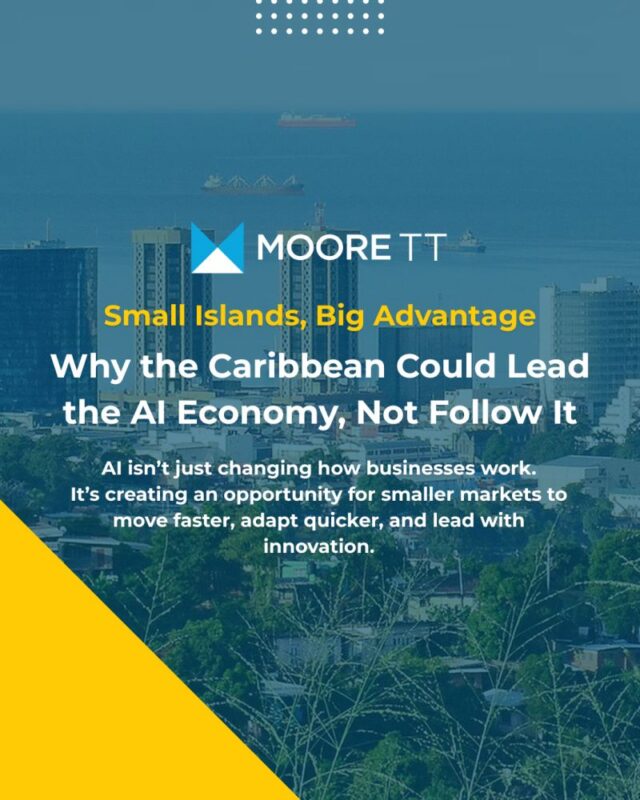
Over the last month, we have focused on AI and the various tenets of adoption. In this final article, we highlight the story we tell ourselves about small markets as one of catching up — waiting for innovation to trickle down from bigger economies. AI flips that script. Being small, agile, and closely connected isn’t a limitation in this race; it’s the advantage larger, slower markets wish they had. The question isn’t whether Trinidad and Tobago and the wider Caribbean can keep pace with AI. It’s whether we realise we’re already positioned to move faster than most.
The Small-Island Advantage
Here’s what leading, not following looks like:
- Piloting AI tools in weeks, not years, because decision-making is close to the ground
- Building AI governance standards suited to Caribbean regulatory realities, rather than importing frameworks that don’t quite fit
- Training regional talent to become AI-literate advisors that clients across the diaspora seek out, not just local competitors
A Regional Reality Check
Consider two firms of similar size: one in a major regional financial hub, one in Port of Spain. The larger-market firm spends months on committee approvals before piloting an AI tool. The firm, with a smaller leadership team and closer client relationships, tests the same tool within weeks, refining it through direct feedback loops the bigger firm simply can’t replicate. Size was never the barrier. Speed of decision-making was the advantage all along.
So, what are the choices in front of us?
- Wait for global standards to arrive, or help shape regional ones now?
- Treat AI as a threat to manage, or a capability to lead with?
- Compete on cost alone, or compete on speed and trust?
The Caribbean doesn’t need permission to lead in AI. It needs the confidence to move first.
What would it take for your business or firm to lead, rather than follow? Let’s build that conversation together.
| Bigger Markets | Caribbean Firms |
|---|---|
| Layers of bureaucracy slow pilot decisions | Leadership can approve a pilot in a single conversation |
| Client relationships are transactional at scale | Close client relationships make trust-building around AI easier |
| Legacy systems resist change | Smaller firms can rebuild processes without years of red tape |